


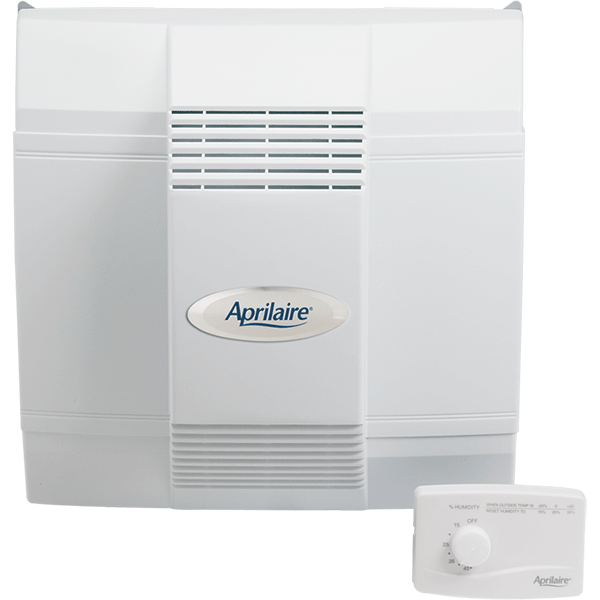
 AprilAire 760 Fan Powered Humidifier Repair Help
Maintenance
Hi, I'm Jay, and this is the AprilAire 700, power style humidifier.
Maintenance on it is going to be very similar to any of the powered humidifiers. The 700, 768, 760, even the 110 and the 112. So the first thing we are going to do, is kill the power and the water to this unit before we do anything. Find the saddle valve, turn it clockwise, until it stops.
Alright, let's take the cover off. On the bottom of this particular model, there's a latch. We're going to pull down on it, pull out, and then lift up, to get if off of the hooks on the top. Now we're just going to set this part on the side. Alright, this is the evaporator pad, we're just going to take it, and pull it out with our hands. Alright, you can snap this apart, take this evaporator pad, throw it away. You're going to rinse off the water distribution tray, and this frame, which is called the scale control insert. They just get washed and rinsed off. Then you put the new pad in, put the top back on, snap it together.
Now this particular model happens to be directional, there's a little groove here that has to go in first, through the back side. Just go like this, slide it into place, and we're going to put the cover back on. On this cover, there are little hooks, here and here, they go in first. So this part is the top. So what you do is you angle it up, like this, get the top hung on there, push the bottom in, and shake to make sure that this thing is latched on. You don't want this thing falling off in the middle of the night. So, it's back on there, and the only thing we have to do now is turn the power and the water back on and test it.
Thank you for watching, for this and other products, visit us at AirQualityParts.com
Troubleshooting: Water Not Running
Hi, I'm Jay, and this is the AprilAire model 700, series 2, humidifier. There's a series 1 and a series 2, we'll get into the differences a little later here. But we're going to figure out why, this particular model does not have any water coming down the drain. We have the unit turned on, and it should be running. So, no water coming down the drain, that means there's a problem. So, first thing we're going to do, is we're going to see if there's water, here in the feed line. Ok, because we do not have water pressure there, even though the water is turned on. So, we're going to disconnect this, but before we do that, we're going to have our assistant, turn the water off. Find the saddle valve, turn it clockwise, until it stops.
Ok, now that the water is turned off, let's open this up and see what we have. You're going to use a 1/2 inch and a 9/16 inch wrench in order to get this apart. Let's get a bucket, and remove this line and stick it in the bucket. Alright, now let's turn the water on. Alright, as you can see, we have plenty of water pressure here. So, we're good to this point. Let's turn the water off. Alright, now, if when my assistant turned that valve on, we had no water here, the problem is the saddle valve. The saddle valves are easy to replace, just buy one from us, and replace it. Now, this particular situation, we have plenty of water here, the problem is not with the saddle valve, it's with the solenoid valve or some other situation, so let's reconnect this and continue testing. And we're going to snag it up with the wrenches. Alright, we still have the power and the water turned off, now we're going to check the outbound side of the solenoid valve to see if there's water there, but it's just not getting into the humidifier. So we're going to get back down here, and we're going to disconnect the feed tube, same wrenches. Alright, we have the feed tube disconnected, let's get out a rag. We're going to hold it on this valve. If things go right, we'll have water here, so what we're going to do is turn the water back on, and then turn the humidifier and the furnace back on, so we can get this valve to open, at least get electricity to it, and see what happens. So let's have our assistant turn the water on, then we'll turn on the furnace and the humidifier.
Still nothing. Ok, so we have water on the inlet side of the solenoid valve. We have no water leaving the solenoid valve. So the only thing left is to determine if there is electricity feeding the solenoid valve. If we had water when I was holding this rag right here, when there was water squirting out of the solenoid valve, then that would show we were good up to this point on the valve. The problem then, would've been right here, on the end of this feed tube there's a tiny little orifice, it's a tiny little nylon piece, about the size of a pencil eraser, and you it can plug up over time, and sometimes they'll just erode and get to have a very large hole in them. There's a microscopic hole in this thing, and it is used to meter the amount of water that goes up to the top of the pad, so you have just enough to wet the pad, and also enough left to wash the pad, and that's what goes down the drain. If this orifice plugs up, we'll have no water going back there. If the orifice completely disintegrates, or the hole in it erodes too large, then you'll have too much water feeding up, in which case you'll have a flood of water coming down the drain. It should be trickling down the drain during normal operation. Let's get this line reconnected. Snug this back up.
Now let's test the solenoid valve itself. So, turn the water back on, turn the furnace back on, and turn the humidifier back on. And we're going to check to see if we have electricity here. There's a couple of ways of doing that. One of them, is the easy way. And it involves taking a screwdriver, a non magnetic screwdriver, like this particular one here. So if I touch this to duct work, or a bolt or something, it doesn't stick to it. Ok, so it's not a magnetic style screw driver. We're going to take this and we're going to touch it to the top of the solenoid valve. Now, this is an electromagnetic valve. So if it's getting electricity, and this valve is trying to open, even though it's not, then they're will be magnetic power right there on the end. We're going to take this, we're going to hold it here, and we're going to check. Ok, now it wants to stick to the top of this valve, so we do have magnetism here, which means that the valve is getting electricity. If it it were not getting power, again, we'd have nothing here. But, because it wants to stick to the top of this valve, that is proving that there is electricity to the valve, the coil is generating an electromagnetic force, and the valve should be open. This valve is not open, so we've determined that this valve is stuck internally. So the valve does need to be replaced, that's a simple job. Buy a new valve from us, stick the new valve in. Now, if we were to determine that we didn't feel any magnetic attraction here, then we want to check for voltage.
We've turned off the power to our humidifier, and furnace. So now what we're going to do is the alternate method of testing this solenoid valve, to see if there's electricity feeding it. These two yellow wires that feed the solenoid valve, are sending 24 volts to it. So we're going to get out some wire cutters, cut these, one at a time, strip the ends. We're going to take about a half an inch off of each end. Let's twist the ends. Now we're going to twist them together, and reconnect them. So, here's this one. So, one from the solenoid valve, and one from the humidifier, and we're going to twist this together. Alright, now that they're reconnected, we're going to get a volt meter, attach it to this, and test for electricity.
Alright, here's our volt meter, we're going to attach the probes carefully, one at a time. So we'll get that one, and the second one. Alright, so we have these connected. We're going to be careful that these are not touching the sheet metal or anything, and they're not rounded out or shorted out to each other. So these are freely hanging, now, we're going to have our assistant turn the furnace back on and the humidifier back on, to see if we have electricity here. Ok, now we have the probes connected to our wires. The humidifier is turned on, the furnace is turned on, everything should be running right now. And we do have electricity. So, as you can see, the voltage is ranging between 19 and 29 volts. That's normal. We have AC power, feeding the valve. Our solenoid valve should be open at this point. And as you can see, we have no water coming down our drain, so the valve is stuck closed, even though it is getting electricity. This is the alternate way of testing if can not use your screwdriver magnet trick on your particular model. So we have power, valve won't open. We have a bad solenoid valve.
Earlier in the video, I mentioned that this was a model 700, series 2. The difference between the 700 series 1 and the series 2 is this. If you look up inside this little grill, you will find that the series 2 has a little relay in it. The series 1 units have a circuit board like this, with a relay and a transformer built on to it. Now, the power humidifiers, up until recently, all had systems like this in it, with a built in transfer and relay. Like the 110's, the 112's, 760's and 768's. They were set up like this. Now, they worked differently than this, which is the series 2. The way they worked, is since they had a built in transformer, you could take these two wires and touch them together in the old series. If you touch them together, and you had electricity coming from the humidifier, from this plug in wire. The humidifier would come on, but they did away with that, so nowadays, since they have this little relay in them, you can't touch these two wires together, because if you do, you're going to blow out something. Probably the transformer at the other end down here, inside the furnace. So it's important that you know if it's a series 1 or a series 2, when doing any kind of testing to determine if one of these two devices, which is hiding inside of this particular humidifier, is faulty. If you get into trouble, and you're trying to figure that out, you can call us for technical support and that. There's typically not problems with those two items, so it's not a real common issue, but if you run into a problem like that, where you have no electricity here, feeding the solenoid valve, and you're confused as to what to do next, you can give us a call and we'll walk you through it. The other thing that I have not mentioned earlier, is to make sure that this cord, is plugged into a live outlet. Easy button for that, is to go to that outlet, unplug the humidifier, and plug something in like a lamp or a radio, just to see if that thing comes on, just to make sure, 100 percent positive, that you do have power going to this socket that this thing is plugged in to. So, on this particular one, we've determined that there's an issue here. And we're going to test about regarding the voltage here, so in the case where you had no voltage here, feeding the solenoid valve, there was another kind of a test that you could do. And that is to listen to the fan inside of this thing to see if it runs. So, if you listen real carefully, and you turn this unit on, now you can't really see the fan inside of here spinning, but if you listen very carefully while the furnace is running, and you have an assistant turning the humidistat up and down, up and down, up and down, and the humidistat is clicking on and off, on and off, often times you can listen and hear inside of this thing, you can hear the humidifier itself making a little clicking noise. And also sometimes you can hear the fan, depending on how quiet your furnace is, you can actually hear the fan inside of here spinning. So that's another way to determine that the humidistat and everything else is working up to this point, and once you know all that's working, and you still don't have a solenoid valve, opening and closing, even though you may not have a way to test this. You don't have a volt meter to test this with. But if you know the fan inside this thing is coming on and off on and off on and off, with the humidistat, well then you know you have power here, and the real problem is the solenoid valve.
Thank you for watching, for this and other products, visit us at AirQualityParts.com
Troubleshooting: Water Leaking
Hi, I'm Jay, and this is the AprilAire 700 Power humidifier. It is roughly the same as the model 110, 112, 760, 768. They're all power style humidifiers. And one of the calls we get on a semi regular basis, is "I have water leaking out of my humidifier." Now, when it's operating, normally, there should be water trickling down the drain. That's normal operation while it's running. However, if you have a situation where there is water leaking out of the bottom out of the humidifier, out of this, frame here. Ok. Or, leaking inside of the furnace. Leaking right here, in this duct work. Or in here. That's a problem, so let's talk about those issues.
Ok, a leak right here that is usually caused by a failure of this connection. Now you can try to tighten this up just a hair, just get a wrench out and give it a twist. If it doesn't solve the problem, what you're going to need to do it take this feed tube with the incoming water, and cut the tube back about an inch, and put a new brass nut on it, a new ferrule, and put it back together. So, that's an easy fix. If you have a leak over here on this side, that is probably just a loose nut, you can sometimes tighten that up. If there's water leaking from the valve itself, the body of the solenoid valve, there's nothing you can do about that, that is often caused by pitting of the valve. The bronze casting has failed, so if that happens, you need to put a new solenoid valve in. Another thing that could happen is, there's a drain spud right here, it's a little nipple that sticks into the bottom of the humidifier. And sometimes when doing maintenance on this, some people over tighten this clamp, right here on the drain spud. And if they over tighten that, they can crush the drain spud, and then at that point, the drain spud needs to be replaced. That drain spud on many models just snaps out, and a new one snaps in so you can easily replace that. The model 700 unit does not have a replaceable drain spud. It is molded into the cabinet base. So if you have a problem where you cracked this, you'll need to purchase a new cabinet base for yours.
Another thing that could happen is this. Sometimes there will be water dripping out of here, which I mentioned earlier. Ok, water leaking out of this section here, or down here. Or inside the duct work.Now what that is usually caused by is a problem here. If you have not replaced your pad in a long time, these pads need to be replaced a minimum of once a year. If this calcifies up and turns into a brick, the water will have nowhere to go, then it will start leaking out. And you'll have water dripping out of the edges here or down in the duct work. Another possibility here is too much water here. If you feed too much water to the top of this, then water will overflow this water distribution tray, and run down the outside and then, into the unit itself or into the duct work. That's normally caused by too much water coming from here. And what meters the water, is a little orifice that's right here in the end of this plastic feed tube. If that orifice fails. The hole in it gets too large, or water just deteriorates the little nylon orifice, and it totally just dissapears. Then you're going to have way too much water feeding through this feed tube, to the top of this distribution tray. That's an easy cure, you just need to put a new orifice in. Let's put this back here. Another possibility, and this is a common one, is this feed tube here. This feed tube is made up of a hard plastic. And over time, chemicals in the water, and the heat from the furnace will make this brittle. And it will crack. So, if you have a crack in this, water will be leaking out of this tube. Just dripping out of the humidifier, and then typically it will be coming out of this bottom seem here or here, where the humidifier touches the duct work. So that's another, rather common, with water leaking out of the humidifier itself. So that pretty much covers all of the problems that are common with water leakage.
Thank you for watching, for this and other products, visit us at AirQualityParts.com
Humidistat Troubleshooting
Digital Humidistat Overview - Model 58/60
This is the model 58, digital humidistat. It comes with an outdoor air sensor, which is this, and also, a manual mode resistor. The manual mode resistor, when installed properly, as this one is, eliminates the need for installing the outdoor air temperature sensor. Now, in manual mode it will not know what the temperature is outside, so we'll NOT automatically adjust the humidity setting up and down, as the temperature changes throughout the day and season.
With the outdoor air temperature sensor, this sensor, when placed outside, will see the outdoor air temperature, and send the appropriate signal back, through the wiring, to the humidistat so it can raise and lower the humidity setting, based on how cold it is outside. And that's actually a better way to do it, that's why they give you both. This is the preferred method, if for some reason you can't put this in, you can always use the manual mode resistor.
Now, this one again has a manual mode resistor installed on it, and we can see right here, it's telling us that the humidity in this duct work right now, in our video studio is 38%. And if we spin this up here, we get it to the point where, we are setting the humidity level higher than that 38%, we've just turned that humidifier on. So it's now running. Now one of the important things is, there is a "test" button here. So, if we spin this all the way around to the "test" mode, the test mode will force the humidifier to run for one minute. And what it's really good for, is checking out your humidifier. So when you do maintenance to your humidifier, even in the summertime, no matter what the humidity is, you can always spin it from left all the way to off, all the way up to test position, it will force, you see the light came on, it forces the humidifier on, it will run it for one minute.
Now after that minute times out. It will start to blink, and the humidifier will no longer be running. So then what you have to do is spin it back around off, and back around on to get it to come back on.
Now the other thing this position does is it says "test" or reset. There is a little light here that says "change water panel" that is not on right now, and what that light is for is it's basically a timer. So after so many hours of operation of this humidistat, telling the humidifier to run, it will bring this little indicator light on that says "change water panel."
Now, it doesn't really know the water panel is bad, it doesn't know the humidifier is working, it doesn't know anything other than like an egg timer, after so many minutes, or in this case, so many hours, it will bring the light on.
Now the way to reset that is each time you change your humidifier pad, you should come around to your humidistat, spin it all the way up, to the "test" or reset position, leave it in that position for about a minute or so, and if you happen to have your "change water panel" light on, when this is happening, it will time out and shut off, then you can, after a minute or two, spin it back to your normal setting.
Thank you for watching, for this and other products, visit us at AirQualityParts.com
Troubleshooting: Humidistat E3 Error - Model 58/60
Hi I'm Jay, and today we are going to talk about how to diagnose your AprilAire digital humidistat. Alright, the light is blinking, and it says "call dealer for service," and we have an E3 fault code. E3 tells us, if you look at your manual, that there's a problem with the outdoor temperature sensor. Now, this one happens to have the "manual mode" resistor on it, so there is a problem with it, because that is what is attached in lieu of the outdoor temperature sensor. So, what we're going to want to do is turn the power off before we start messing with this thing, so let's kill the power first. Now that the power's turned off, let's take off the cover, pull the knob and snap off the cover. Ok, now if we take a look inside there, and we look real close at this manual mode resistor, you can see that the two wires that come from it are shorted out against each other, so we're just going to straighten that out. There we go, that's now straightened out, they were shorted out before, and now they're no longer shorted, so, they're separated, we're just going to go ahead while we're in here and just tighten up these two screws, attached to it, make sure they're tight, very good.
Alright, now we can put the cover on and turn the power back on and see what happens. Ok, we've separated the two wires that were touching each other on this manual mode resistor. We have the power back on. The "call dealer for service" light is no longer on. It no longer says E3 error code. Let's spin this around, see if our humidifier comes back on and test--Yep, our humidifier comes on. 36 percent, alright everything appears to be working just great now. So our only problem is our wires for the manual mode resistor were shorted out to each other.
Now the same thing will happen if one of the wires breaks, or if this manual mode resistor were to fail. That E3 code is telling you, that the value that is it looking for, is within a range, from X to Y, and it is out of range. It is either, not enough resistance, in other words shorted out, or a resistance value that's too high. Which would mean that one of the wires was broken. The same holds true for the outdoor temperature sensor. So here's an outdoor temperature sensor. Right here. Normally, for a lot of people, this is what is attached to those two terminals, the ODT Terminals, in lieu of this little resistor.
So what often happens with these is this little sensor here is stuck on an outside wall and maybe your dog chewed on it, or someone hit it with an implement or a tool. Uh, lawnmower or whatever. They've broken it. So once you break this device, you will have no signal coming back to the control, and it will kick up the E3 failure code. So, we're going to show you how to check this.
Now, we have the 58 model humidistat, and this has an outdoor temperature sensor on it. And everything is working fine, and we can flip this thing over here. If you take a look at the display, it says 37%, that's the humidity here in our video studio, we spin it around and we can get it turned on, we spin it to the test position. It says humidifier on, so we are now running the humidifier. We'll run it for about a minute, then it will start to blink, and it will eventually turn off the humidifier after one minute.
So we're going to see what happens when we have a fault code. And, the fault code we are going to use is E3. Ok, now we have an E3 error code, which is telling us there is a problem with the outdoor temperature sensor. So, we're going to turn off the power to the unit, get a meter out and check it. First thing we want to do, again, is turn off the power. Ok, we turned off the power to the furnace, and the humidifier. The display is blank, right now, so we're going to find out why we have an E3 error code.
Let's take the cover off, and right here we have the terminals, that are marked, ODT. Ok, we're going to disconnect these two wires, so we can get the sensor wires in our hands. Ok, I'm going to pull them both out.
Alright we're going to get our meter out and check the OHM value that we're reading here. Ok, there we go. So it says "overload." so, it's infinite resistance, basically. Which means, it's not seeing anything. So it doesn't see our outdoor air sensor at all. So what we're going to want to do is find out why, so we can go out to the sensor outside and take a look at it, and find out.
Ok, so we've gone outside and we've taken a look at out outdoor temperature sensor, and here's the new one, and we've found out that the end of this, of the temperature sensor outside, is missing. So it must have got hit by a shovel, or a dog chewed the end of it off, but anyways we're going to replace it. And see what happens.
So here's the new one, we're going to go outside and replace this now. Ok, so we've replaced the outdoor temperature sensor, and if we take a look here, kind of hard to see, but it says 46.4 K. So it's 46.4 thousand OHMS, resistance. Ok, so that equates, if you look at the chart in the owner's manual, that equates to about 20 degrees Fahrenheit outside. which, oddly enough, it happens to be. So it's 20 degrees outside, we get a value here of 46.4 thousand OHMS, that matches the temperature outside, everything is good.
So now all we have to do is reconnect these wires, and turn the power back on and test it. Ok, let's disconnect these, we're going to reinstall these wires. Let's put the cover back on. Reinstall the knob, there we are. Alright, leave that off for now. Now we'll turn the power back on and test it.
Ok, so we've switched the power back on, and as you can see, everything is working again, we no longer have the E3 error code, is telling us that the humidity in our space is 37 percent, and that is correct, so we're going to spin this around, and see if the humidifier will come on. Alright, we're spinning it around in the test position just for the heck of it, humidifier light came on, the humidifier is now running, everything is working great. So, we're fixed. Now we can set this back, to whatever setting we want. So we're going to leave it on 5 right now.
Thank you for watching, for this and other products, visit us, at AirQualityParts.com.
Troubleshooting: Humidistat No Display - Model 58/60
Hi, I'm Jay, and today we are going to talk about how to diagnose your AprilAire digital humidistat. Ok, this digital humidistat has no display right now. So, we're going to check for electricity to make sure that it has power, if it doesn't have power, the problem is ahead of it somewhere. If it does have power and the display is dead, that's a bad humidistat.
Ok, let's take the cover off and check for voltage. Ok, we're going to check at the R terminal and the C terminal. And according to my meter, I have .001 volts so I have no power here. So we should be reading anywhere from 0.22 to 0.29 volts at this point. Since I don't have any electricity, the problem is probably in the furnace, or a transformer somewhere, but it is not with the humidistat. If I had power here, and the display was blank like this, I would have a bad humidistat, which would need to be replaced.
Thank you for watching. For this and other product, visit us at AirQualityParts.com.
FAQs
HVAC Typical Layout Overview
Hi, I'm Jay, and this is our demo unit. We often get questions asking what the individual components are, so we thought we'd talk about that today. So, on this demo unit, this is the return air duct work, so this would be the duct work that brings the air from your home into the furnace to get heated or cooled. So, on the side here we happened to have a return air grill, like you typically find on the wall or ceiling of a home. The air would come down here, through the return air grill, down this duct.
This happens to be a humidistat. This can be mounted on the return air duct, which is the most common location you'll find these humidistats. This one is a digital one, there are mechanical ones as well. They are, again, most often mounted on the return air duct. Although sometimes they can be mounted, certain models at least, inside the home. And when they're done that way, they are often very closely mounted to the thermostat. so, like within a foot or two of the thermostat.
So anyways the air from your home would be sucked into the return air grill, come down this duct, go this way, turn, go through the air cleaner, into the furnace, there's a blower down here in this furnace, inside here is the heating chamber, so it goes through the heat exchanger, the air goes up through the heat exchanger, this happens to be a cooling coil, so if you have air conditioning, you'll have one of these directly above your furnace. So, inside of this is a radiator looking device, so the air that goes through this would be cooled in the summertime, and it goes up into the supply plenum, and gets discharged into your home. So, in the wintertime, the supply plenum would be hot air into this, and it would blow up into the duct work, and come out of the registers in your house.
This is the flu pipe, for the furnace, we don't happen to have a gas line attached to this demo unit, but if we did, the gas would go up through this and outside the home.
The air cleaner here, this happens to be the AprilAire 5000 air cleaner, and if you look closely at the front, you'll see it mentions the model number here, so the air comes from your home, through the return air grill, down the return air duct, happens to pass the humidistat, goes down, goes through the air cleaner, gets cleaned, goes into the furnace, gets heated in the wintertime, or, cooled in the summertime, comes out into the supply plenum, and gets blown back into your home.
Our demo unit has a humidifier, this is a 600 model AprilAire, mounted on the side of it, you'll see that there's a model number here, and there's also a sticker over here on the side. That gives you the model and serial number. This one being a 600, it's a bypass style humidifier. So there's a 6 inch around bypass duct that's attached here, it comes around, and it's attached to the return air duct work, which we discussed earlier. There is also a drain line on this humidifier, so whenever the humidifier is running, water will trickle down the drain. Here's the water line. And this is the low voltage control wiring, for the humidifier. That drain comes down here, then gets attached to the air conditioner drain here. They go down, this particular model happens to be set up with a condensate pump, for our demonstration room here.
This is the cooling coil, supply plenum, so in the wintertime, the furnace would heat the air, it would then blow it through the cooling coil which would not be functional in the winter time, the air would then go into the supply plenum here, go up, and then come out and get blown into your home.
Thank you for watching, for this and other products, visit us at AirQualityParts.com
Documentation

Still Need Help?
Live help is available. Feel free to contact us.
Browser Not Supported
You are using Internet Explorer as your browser, which is no longer supported by our website. Because of this, you can view products but not place orders using Internet Explorer on our site.
Please update your browser to any of the modern browsers listed below or use a different internet browser to place an order on this site.
If you have any questions or need assistance with placing an order, please contact us at 800-825-2148 or [email protected]


